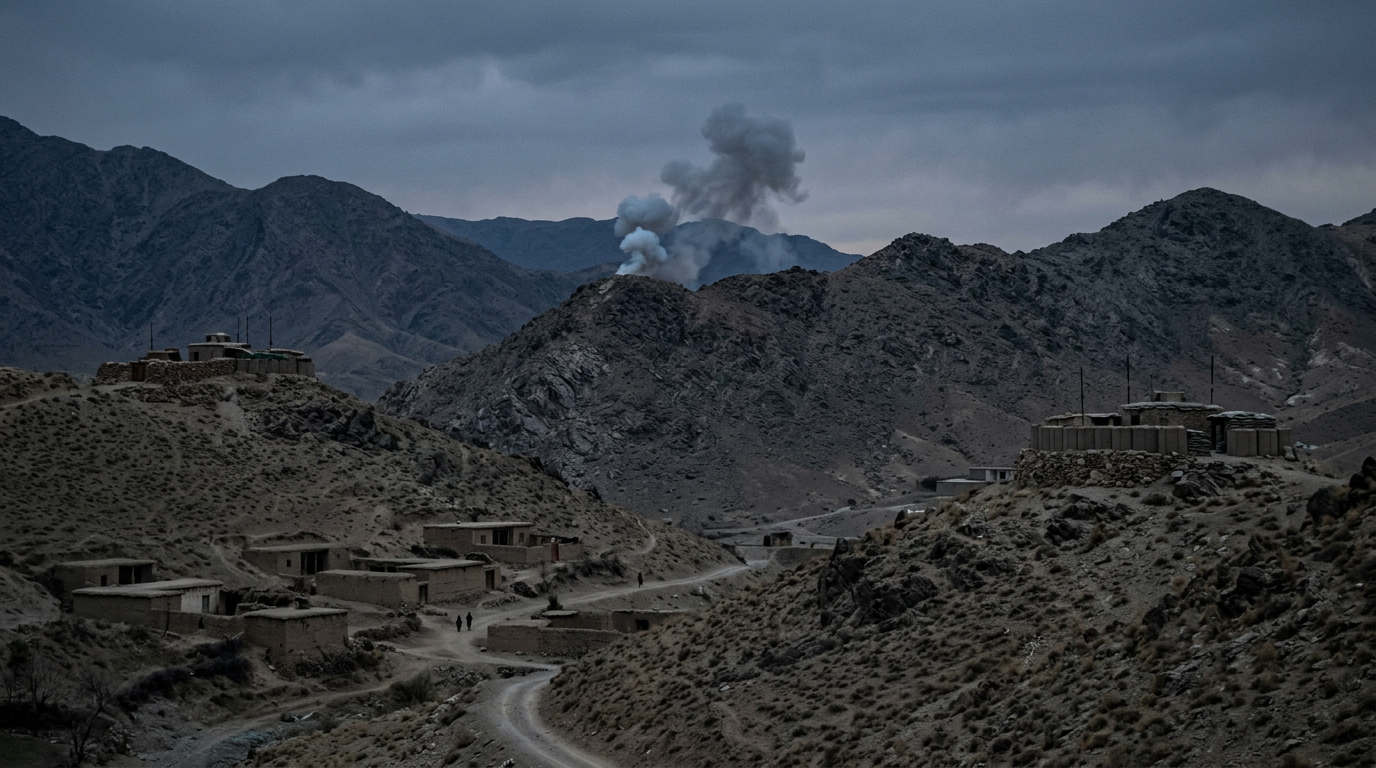

Pakistani airstrikes inside eastern Afghanistan have triggered one of the most serious cross-border escalations in months, with the United Nations reporting at least 13 civilian deaths and seven injuries following strikes conducted late February 21 into early February 22. Within days, Afghan Taliban authorities announced what they described as “large-scale offensive operations” against Pakistani military positions along the disputed Durand Line.
What began as what Islamabad called “intelligence-based precision strikes” on militant camps linked to Tehreek-e-Taliban Pakistan (TTP) and Islamic State Khorasan Province (ISKP) has now evolved into sustained cross-border exchanges. Both sides claim to have inflicted heavy losses. Independent verification of battlefield casualty figures remains limited due to restricted access and conflicting official accounts.
Where the Fighting Is Concentrated
Clashes are unfolding across multiple sectors of the 2,600-kilometre Durand Line, a colonial-era frontier drawn in 1893 that remains politically contested. Reported flashpoints include Pakistan’s Khyber Pakhtunkhwa province and Afghanistan’s Nangarhar, Paktika, Khost, and Kunar provinces.
Particular attention has focused on the Torkham border crossing, a critical economic artery connecting the two countries. Shelling has reportedly landed near civilian-adjacent areas, prompting precautionary evacuations and raising concerns over renewed trade disruptions. Previous escalations along this corridor have quickly translated into stranded cargo, halted commerce, and rising food and fuel insecurity.
What Each Side Says
Pakistan’s government frames the strikes as lawful self-defense against cross-border militancy. Officials say TTP and ISKP networks operate from Afghan territory and have launched attacks inside Pakistan. The Ministry of Foreign Affairs stated that Pakistan would respond “swiftly and strongly” in defense of its sovereignty, describing the February 21–22 strikes as targeted actions against seven militant hideouts.
Taliban authorities reject those accusations, calling the strikes violations of Afghan sovereignty. Spokesperson Zabihullah Mujahid announced retaliatory operations on February 26, warning that continued Pakistani attacks could widen the confrontation. Taliban-linked sources claim significant Pakistani military casualties and the seizure of border posts—claims Islamabad denies.
Reuters and other agencies have explicitly noted that they cannot independently verify many of the casualty and territorial claims issued by either side. This verification gap underscores the difficulty of assessing battlefield outcomes in remote and heavily controlled frontier terrain.
Verified Facts and Contested Claims
What is verifiable at this stage is limited but significant. Pakistani airstrikes occurred. UN officials reported credible evidence of at least 13 civilian deaths and seven injuries in Nangarhar Province. Cross-border exchanges of fire have been confirmed by both governments. Disruptions near key crossings have been reported.
What remains contested are the scale of military losses, claims of captured posts, and precise territorial changes. Casualty numbers differ sharply between Pakistani and Taliban accounts. Without independent access, these figures must be treated as claims rather than established facts.
Why This Conflict Repeats
The structural driver of repeated escalation lies in the long-standing dispute over militant sanctuaries. Pakistan accuses the Taliban administration of tolerating or failing to suppress TTP networks operating from Afghan soil. Taliban officials deny the presence of such groups and frame Pakistani strikes as unjustified aggression.
A late-2025 UN sanctions-monitoring report stated that Taliban claims that no terrorist groups operate from Afghan territory were “not credible,” highlighting that TTP attacks originating from Afghan soil have contributed to cross-border clashes and trade disruption. That assessment reinforces a cycle: militant attack, retaliatory strike, border firefight, economic closure.
Ceasefire Framework Under Pressure
The October 2025 crisis prompted mediation efforts involving Türkiye and Qatar, including discussions in Doha and Istanbul aimed at solidifying a ceasefire and establishing a monitoring and verification mechanism. The renewed violence raises questions about whether that mechanism ever became fully operational—or whether political will eroded under renewed militant activity.
The current flare-up suggests that enforcement architecture was either insufficient or unsustained. Without credible monitoring, retaliation logic can quickly override diplomatic commitments.
Economic and Regional Stakes
The Afghanistan–Pakistan frontier is not merely a security boundary but a commercial lifeline. Pakistan serves as a primary transit corridor for landlocked Afghanistan. Extended closures at crossings such as Torkham and Chaman can rapidly evolve into supply-chain crises affecting food, fuel, and medical imports.
Beyond trade, the broader refugee backdrop raises the stakes. Pakistan hosts an estimated three million Afghans. Renewed instability complicates return movements and increases vulnerability among displaced populations dependent on border stability.
At a strategic level, escalation risk draws heightened international attention because Pakistan is one of the world’s nuclear-armed states. While current fighting remains geographically limited, miscalculation risk cannot be ignored.
What to Watch Next
Expect continued information warfare in the form of dueling casualty figures and disputed battlefield claims. Additional cross-border exchanges are likely if retaliatory cycles continue. Border controls may tighten further, and intermittent closures remain a strong possibility.
Pressure for renewed third-party mediation could intensify if civilian harm increases or trade paralysis deepens. The immediate trajectory appears to be localized escalation rather than full-scale war, but volatility remains high.
For now, what is clear is this: verified civilian deaths, confirmed cross-border fire, and a fragile ceasefire architecture under strain. What is disputed are military outcomes and territorial claims. Along a disputed frontier shaped by history and militant dynamics, escalation can outpace verification—and stability depends on whether diplomatic channels regain primacy before retaliation logic takes hold.