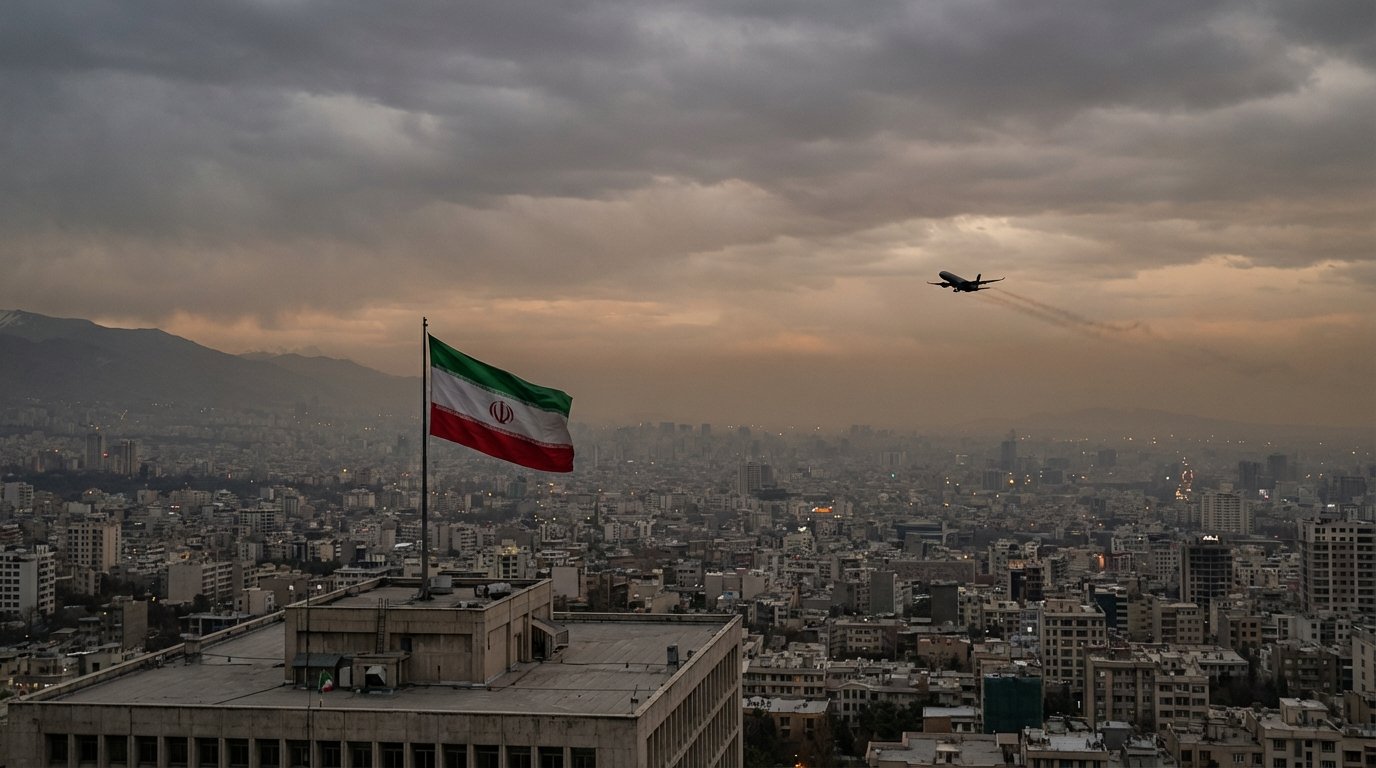

China has ordered its citizens to leave Iran “as soon as possible.” The directive, issued on February 27, 2026, comes as U.S.–Iran tensions intensify and multiple governments quietly begin withdrawing personnel from the region.
Beijing framed the move as a response to “heightened external security risks.” Yet the timing—amid Iranian military drills near the Strait of Hormuz, renewed weapons negotiations with Russia and China, and accelerating diplomatic withdrawals by European and Asian states—suggests something more than routine caution.
While nuclear negotiations between Washington and Tehran continue in Geneva, the security environment across the Middle East is deteriorating at speed. The question is no longer whether tensions are rising. It is whether escalation is becoming structurally embedded.
A Precaution — or a Signal?
China’s evacuation advisory is officially precautionary. Beijing has increasingly treated the protection of overseas nationals as a core diplomatic responsibility, a policy sharpened after large-scale evacuations from Libya in 2011 and Sudan in 2023.
But this advisory differs in tone. The instruction to depart “as soon as possible” reflects an assessment that the risk threshold has crossed into unpredictability. Similar warnings have been issued by Poland, India, Germany, Serbia, Sweden, Australia, and the United States, which has withdrawn non-essential diplomatic staff from Lebanon.
When multiple intelligence services reach similar conclusions at the same time, it rarely reflects coincidence. It reflects converging risk calculations.
Diplomacy Continues — Militaries Prepare
Technical nuclear talks in Geneva have reportedly shown limited procedural progress. Yet parallel developments tell a different story. Iran’s Islamic Revolutionary Guard Corps has conducted exercises simulating “shore-to-sea fire” operations near the Strait of Hormuz, alongside drone deployments intended to signal deterrence.
Simultaneously, Iran is accelerating negotiations with Russia and China for advanced weaponry. Reports indicate discussions involving anti-ship cruise missiles, portable air defense systems (MANPADS), and potentially more sophisticated long-range air defense platforms. These talks intensified after Iran’s S-300 systems were reportedly degraded in 2024, leaving gaps in its aerial defense umbrella.
Washington, for its part, has increased military deployments in the region while continuing its “maximum pressure” sanctions campaign, including actions targeting Iranian oil exports.
Diplomats speak of de-escalation. Militaries rehearse contingency.
China’s Strategic Hedge
Beijing is not distancing itself from Tehran. It is hedging.
China currently purchases approximately 90 percent of Iran’s oil exports, providing Tehran with critical economic oxygen despite U.S. sanctions. It has integrated Iran into the Shanghai Cooperation Organisation and BRICS, embedding the country within a broader counter-Western institutional architecture.
At the same time, China avoids direct military entanglement. This is consistent with its doctrine of “strategic patience”: preserve partners through economic and diplomatic means while avoiding confrontation that could escalate into great-power conflict.
The evacuation order therefore serves two purposes. Domestically, it protects Beijing from political fallout should conflict erupt. Strategically, it allows China to continue supporting Iran through non-combat channels without exposing its citizens to risk.
Air Defense Weakness and Urgent Procurement
Iran’s urgency in seeking advanced air defense systems reveals structural vulnerabilities. Indigenous platforms such as the Bavar 373 have not demonstrated reliability against high-end Western strike capabilities. The loss of Russian-supplied S-300 systems further weakened layered defense coverage.
In response, Tehran is reportedly negotiating oil-for-weapons arrangements to bypass sanctions constraints. Systems under discussion include short-range infrared missile platforms, anti-ship missiles designed to threaten naval assets in the Persian Gulf, and potentially more advanced Chinese systems such as the HQ-9.
These are not acquisitions made from a position of comfort. They are acquisitions made under pressure.
Regional Instability Beyond the U.S.–Iran Axis
The deterioration is not limited to bilateral tension. ISIS has declared what it calls a “new chapter of resistance” in Syria, launching renewed attacks amid transitional instability. The Lebanese government has reportedly received warnings of potential Israeli strikes should Hezbollah intervene in any U.S.–Iran confrontation.
Inside Iran, student-led protests have expanded beyond universities into secondary schools, reflecting generational discontent compounded by record inflation and economic strain. Domestic fragility adds another layer of unpredictability to Tehran’s calculations.
The convergence of external pressure and internal dissent narrows the regime’s margin for strategic miscalculation.
Non-Interference Under Strain
China’s foreign policy doctrine has long emphasized non-interference. Yet modern geopolitics increasingly forces reinterpretation. Protecting energy corridors, safeguarding overseas nationals, and stabilizing partner regimes require more than passive diplomacy.
Beijing’s approach can be described as “creative involvement.” It does not deploy troops. It does not issue ultimatums. Instead, it deploys capital, purchases oil, participates in joint naval exercises, and offers diplomatic shielding at the UN Security Council.
This model mirrors China’s positioning during the Ukraine conflict: avoid direct combat participation while ensuring that strategic partners remain economically viable.
Energy Markets and Escalation Risk
The Strait of Hormuz remains one of the world’s most critical maritime chokepoints. Any military confrontation affecting shipping lanes would reverberate across global oil markets.
China’s evacuation order, combined with multinational withdrawals, signals that major powers are preparing for disruption scenarios—even if none publicly predict immediate war.
Markets respond not only to conflict, but to the probability of conflict. The probability has increased.
Realignment or Managed Pressure?
Two interpretations dominate strategic analysis.
The first sees the crisis as part of a broader geopolitical realignment: Iran embedded within a China–Russia axis challenging U.S. primacy, institutionalized through SCO and BRICS integration.
The second sees a controlled escalation—maximum pressure designed to extract concessions while avoiding full-scale war.
The evacuation wave complicates the second theory. Governments rarely advise immediate departures if they believe escalation remains tightly managed.
What Comes Next
Three indicators will determine whether this moment stabilizes or fractures further.
First, whether military exercises remain symbolic or transition into live operational deployments. Second, whether Geneva negotiations produce tangible confidence-building steps. Third, whether additional countries expand evacuation orders beyond dependents and non-essential staff.
China’s order does not mean war is inevitable. It does mean that Beijing believes the margin for error is narrowing.
In geopolitics, evacuation notices are rarely about optics. They are about probability. And probability, for now, is rising.