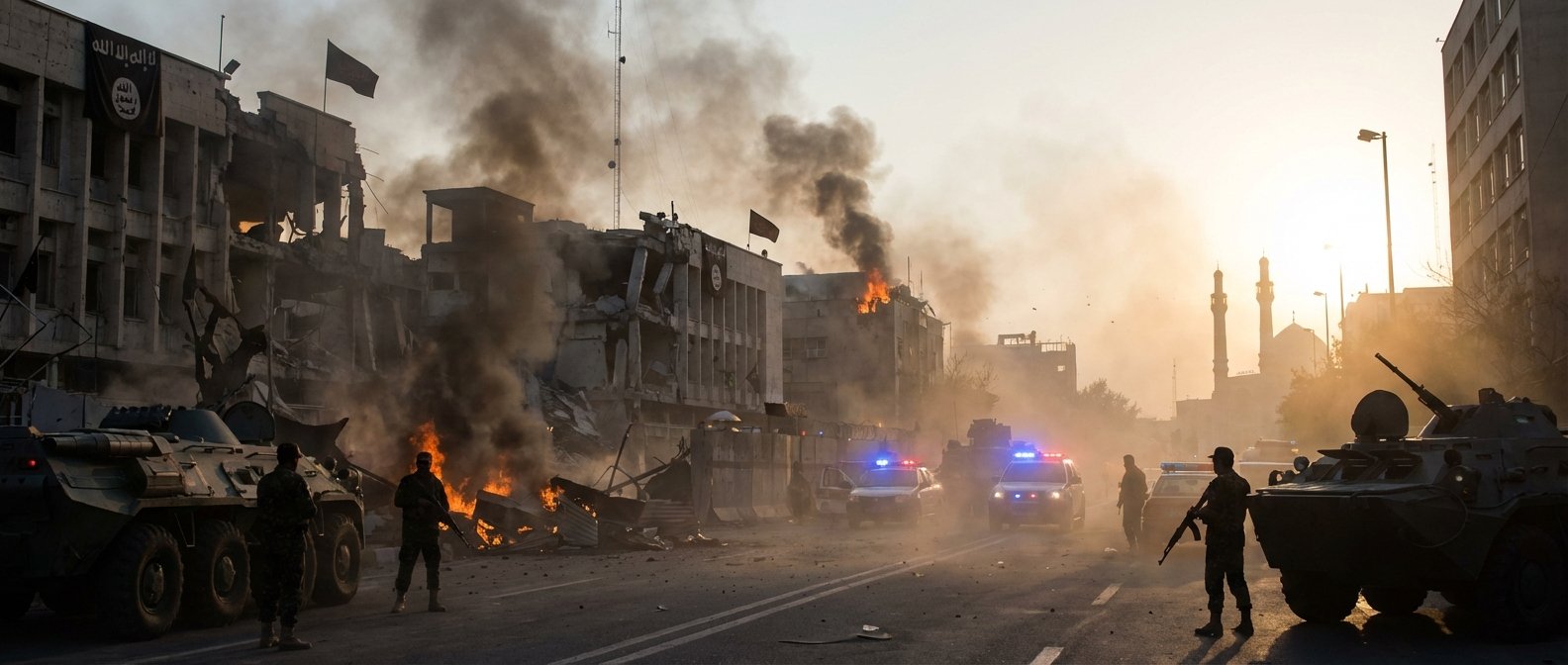

At 5:00 am Tehran time on Sunday, March 1, 2026, Islamic Republic of Iran Broadcasting interrupted its regular programming. A television anchor read a statement informing "the noble and proud people of Iran" that Supreme Leader Ali Khamenei had "achieved the blessing of martyrdom." A black mourning banner filled the screen. Quranic recitations replaced the usual broadcast. The Islamic Republic, in its own words, confirmed what U.S. President Donald Trump had announced hours earlier via Truth Social: the eighty-six-year-old man who had governed Iran for thirty-five years was dead.
The operation that killed him — designated Operation Epic Fury by the United States and Operation Roaring Lion by Israel — was executed on the evening of February 28, 2026. Airbus satellite imagery captured the destruction of Khamenei's secure compound on Pasteur Street in central Tehran. U.S. Central Command released aerial footage of munitions striking buildings, a radar tower, and a missile battery. AP photographers documented smoke rising across the Tehran skyline. Iranian state media initially claimed the Supreme Leader was "safe and sound." Within hours, that position became untenable. The Iranian Cabinet declared forty days of national mourning and a seven-day public holiday. The body, Israeli officials stated, had been recovered from the wreckage.
The Scope of What Was Struck
This was not a targeted killing in the conventional sense. The operation targeted a meeting of Iran's Defense Council, eliminating not just Khamenei but a significant portion of the command structure around him. IRGC Ground Forces chief Mohammad Pakpour and Defense Minister Aziz Nasirzadeh were among those confirmed killed. The Iranian Red Crescent reported over two hundred fatalities across the country in the initial hours. The Israeli Air Force struck approximately five hundred targets in central and western Iran. U.S. Tomahawk missiles and autonomous drone swarms were used to overwhelm air defense networks across eighteen provinces.
The stated objectives went beyond any single individual. President Trump described the strikes as necessary to "impede nuclear and missile programs" and eliminate "imminent threats" to American forces in the region. Prime Minister Benjamin Netanyahu framed the operation as removing "the existential threat posed by the terrorist regime." At an emergency UN Security Council session, U.S. Ambassador Mike Waltz insisted the action was "lawful," arguing that preventing Iranian nuclear acquisition "is not a matter of politics — it's a matter of global security." Israel's UN Ambassador Danny Danon told the Council that "diplomacy was exhausted." Neither government provided a formal legal opinion under international law. Neither has been asked to by any body with enforcement authority.
Russia condemned the strikes as "unprovoked armed aggression" and requested an emergency session of the IAEA Board of Governors, scheduled for March 2, to address strikes near facilities under international safeguards. China's response was more measured: its embassy in Tehran began registering citizens for evacuation to Azerbaijan, Armenia, and Turkey. EU foreign policy chief Kaja Kallas called for a virtual Foreign Affairs Council meeting and warned the conflict risks "dragging the region into a broader war." The Arab League's UN observer accused Israel of using the conflict to impose "hegemony on the Middle East."
Operation True Promise 4
Iran's response, designated Operation True Promise 4, has been neither symbolic nor contained. The IRGC vowed "the most ferocious offensive operation in history" and moved toward its execution. Ballistic missiles and drones have struck targets across the Gulf: three buildings at the U.S. Navy 5th Fleet headquarters in Bahrain sustained damage; explosions were reported at Al-Udeid Airbase in Qatar; shrapnel injuries were recorded at Ali Al-Salem Air Base in Kuwait. Strikes reached Riyadh and the Eastern Province of Saudi Arabia. Jordan intercepted forty-nine drones and missiles over its territory. Tel Nof Airbase and the IDF's HaKirya command headquarters in Tel Aviv were specifically targeted.
The economic dimension of the retaliation is more immediately consequential than any single military strike. The IRGC contacted commercial vessels to announce the closure of the Strait of Hormuz — the chokepoint through which approximately one-third of the world's seaborne oil exports passed in 2025. A Palau-flagged oil tanker, the Skylight, was attacked in the strait, wounding four mariners. Dubai International Airport was struck and closed. Fires broke out at Dubai's Jebel Ali Port. Debris from interceptions damaged the facade of the Burj Al Arab. CMA CGM suspended Suez Canal passage, rerouting vessels via the Cape of Good Hope. The friction costs to global shipping are already accumulating. The energy market implications of a sustained Hormuz closure are not theoretical.
Beyond the Gulf, the regional architecture is fragmenting in unexpected directions. Supporters of the regime stormed the U.S. consulate in Karachi, killing at least eight people. The "Islamic Resistance in Iraq" claimed drone attacks on a U.S. base in Erbil. And in a development that would have been inconceivable a year ago, Syria's Foreign Ministry — representing a government that spent decades in close alliance with Tehran — condemned Iran's retaliatory strikes on Gulf monarchies, signaling a deliberate pivot toward Washington and regional economic powers.
The Constitutional Void
Iran has no mechanism it fully trusts for what comes next. The position of Vice Supreme Leader was abolished in 1989. Khamenei designated no successor. Article 111 of the Iranian Constitution requires a three-member leadership council to assume interim duties until the Assembly of Experts — a body of eighty-eight religious scholars — selects a permanent replacement. That council currently consists of President Masoud Pezeshkian, Judiciary Chief Gholamhossein Mohseni Ejei, and a jurist from the Guardian Council. It is a constitutional arrangement designed for an orderly transition. The current circumstances are not orderly.
The names circulating as potential permanent successors reflect the fault lines within the system. Mojtaba Khamenei, the late leader's son, is frequently discussed but faces opposition over his relatively low clerical rank and the dynastic optics of his candidacy. Ali Larijani, former parliamentary speaker and Secretary of the Supreme National Security Council, is seen as a pragmatist with institutional credibility. Hassan Khomeini, grandson of the Islamic Republic's founder, carries reformist associations that would generate hardline opposition. Mohammad Mirbagheri is favored by conservative religious factions. The Assembly of Experts is the formal selection mechanism. Whether it retains the practical authority to exercise that function is a separate question.
The IRGC is the variable that makes every other analysis provisional. Several of its senior commanders were killed in the strikes. Ahmad Vahidi — a former defense minister currently under U.S. sanctions — has been appointed as the organization's new commander. The Guard's immediate tasks are military retaliation and internal security: IRGC units and Basij paramilitaries have flooded residential neighborhoods in Tehran to suppress any civilian challenge to regime continuity. But analysts note that the IRGC, as the most coherent institutional power remaining in the country, has both the motive and the capacity to bypass the clerical selection process entirely and move toward a military government. That outcome would represent a fundamental transformation of the Islamic Republic's character — assuming the Islamic Republic, as a governing form, survives at all.
The Unaccounted Variables
Two facts from the strategic assessment produced before the strikes now carry particular weight. Approximately four hundred kilograms of sixty-percent enriched uranium remain unaccounted for in the post-strike environment. The strikes may have degraded Iran's nuclear infrastructure. They have not destroyed Iran's nuclear material or the scientific knowledge required to work with it. The second fact is related: analysts had assessed before the operation that sustained military pressure against Iran increased, rather than decreased, the probability that the regime would move toward weaponization as the only remaining guarantee of survival. Whether that logic still applies — and to whom, in a system now without a supreme leader — is a question with no current answer.
The stated American objective is regime change and the liberation of the Iranian people. The institutional reality is a country of ninety million people, a Revolutionary Guard that still controls the security apparatus, a nuclear materials stockpile without a confirmed location, a closed international waterway, and a succession contest among factions whose relative strength will only become visible over weeks and months of internal conflict. Trump described the strikes as the "single greatest chance" for Iranians to reclaim their country. What that chance produces — a democratic transition, a military republic, a prolonged civil conflict, or a nuclear-armed successor state — is not determined by the strike that created it. The morning after a decapitation is always the hardest part. It has arrived.